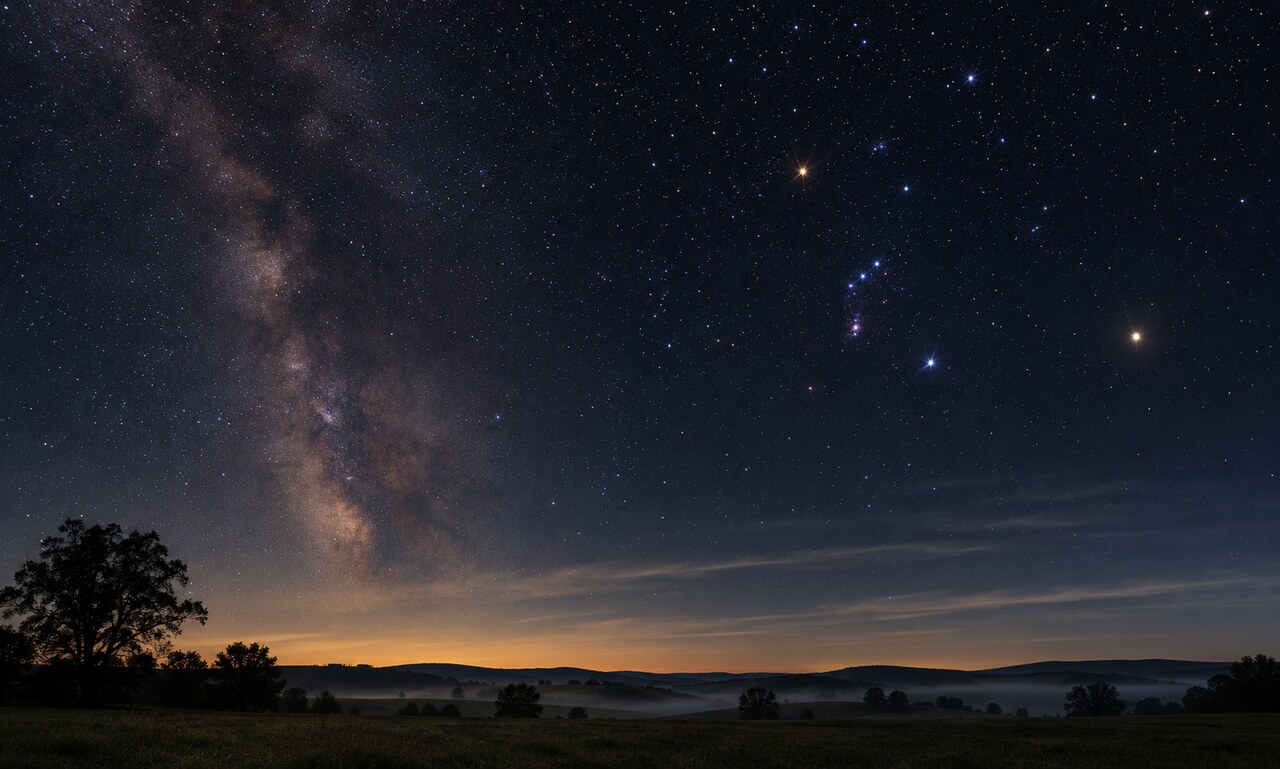
On a clear night, a bright star can seem to flicker, jump or flash through several colors. A nearby planet may shine with a steadier light. Both objects are seen through the same atmosphere, so the difference begins with how their light reaches the eye.
Stars are so distant that they appear almost like points.
The atmosphere is always moving
Air is not a perfectly uniform layer. Pockets with different temperatures and densities move across the sky. Each pocket bends light by a slightly different amount as the light travels toward an observer.
For a point-like star, those changing paths can shift the apparent position and brightness many times each second. The effect is called atmospheric scintillation. The eye interprets the rapid variation as twinkling.
Color can flicker too
Different wavelengths of light bend by slightly different amounts. Strong turbulence can briefly separate colors enough for a bright star to flash red, blue or green. The star itself is not rapidly changing color; the atmosphere is changing how its light is delivered.
Twinkling is often stronger close to the horizon because the light passes through a longer path in the atmosphere. More moving air lies between the object and the observer.
A planet is a tiny disk
Planets are much closer than stars. Even when they look like points to the unaided eye, they present a small disk with light arriving from many adjacent parts. Atmospheric motion may brighten one part while dimming another. Those variations tend to average together, producing a steadier appearance.
Planets can still twinkle when they are low in the sky or when the atmosphere is especially unsettled. The distinction is useful, not absolute.
Astronomers work around the shimmer
Twinkling can blur fine detail in telescope observations. Large observatories are often built at high, dry sites where less atmosphere and steadier air sit above the instrument. Some telescopes use adaptive optics, rapidly changing a mirror's shape to correct measured distortion.
Space telescopes avoid atmospheric turbulence entirely, which is one reason they can produce such sharp views.
The night sky appears still, but starlight reveals motion in the air above us. Each twinkle is a distant point of light tracing the restless structure of Earth's atmosphere.
READ NEXT