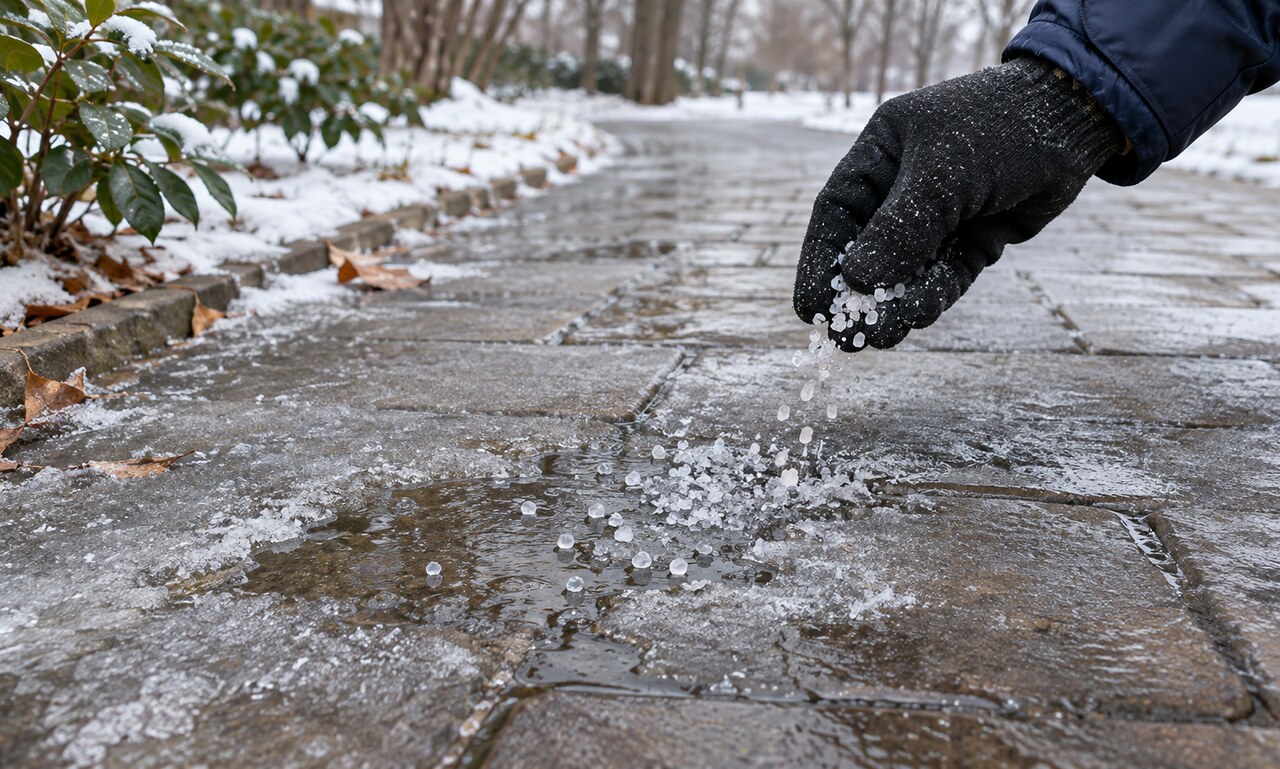
Sprinkle salt onto an icy walkway and wet patches begin to form around the grains. The salt is not adding heat. It changes the conditions under which liquid water and solid ice can exist together.
A thin liquid layer starts the process
Even below the usual freezing point, the surface of ice has a microscopic layer of mobile water molecules. Salt dissolves into that layer and separates into ions. The resulting solution has a lower freezing point than pure water.
At the same temperature, more ice must melt to bring the system toward a new balance. As liquid forms, it dissolves more salt and spreads the effect across the surface.
Dissolved particles disrupt freezing
For water to freeze, molecules need to arrange themselves into an ordered crystal. Dissolved ions make that arrangement less favorable. The reduction in freezing point depends largely on how many dissolved particles are present, which is why different salts and concentrations behave differently.
The process is called freezing-point depression. It also helps explain why seawater freezes at a lower temperature than fresh water.
Melting has limits
Salt becomes less effective as temperatures fall. Each salt-and-water mixture has a lowest temperature at which liquid can remain stable. Below that point, adding more of the same material will not create useful melting.
Ordinary sodium chloride works well near the freezing point but loses practical effectiveness in deeper cold. Other deicers may function at lower temperatures, although cost and environmental effects vary.
Removal still matters
Deicer works best on a thin remaining layer after loose snow has been cleared mechanically. Heavy application does not automatically melt faster and can damage plants, affect soil and waterways, irritate animal paws, and corrode metals or concrete.
Grit and sand provide traction but do not significantly lower the freezing point. They solve a different problem.
Salt melts ice by changing a phase boundary, not by warming the pavement. A small amount of dissolved material lets liquid water persist in conditions where pure water would otherwise lock into a crystal.
READ NEXT