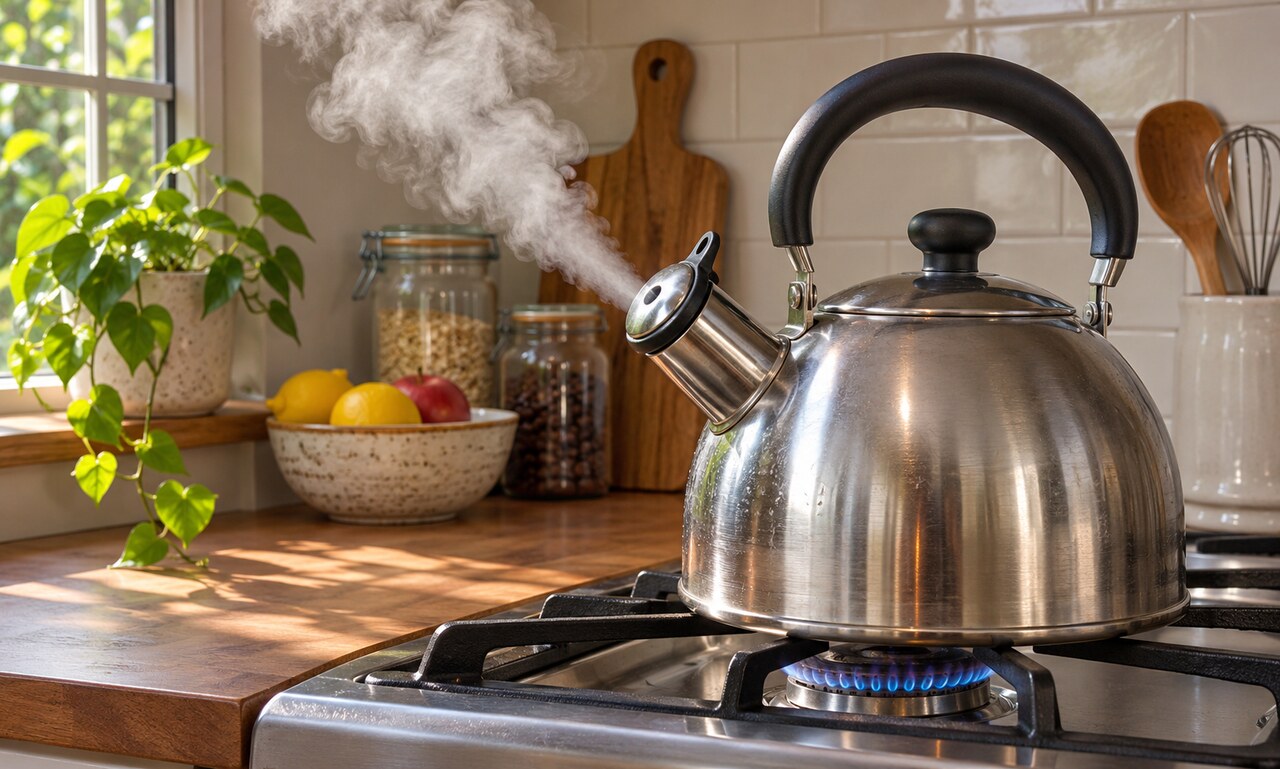
A whistling kettle is a compact sound-making system powered by heat. The water provides steam, the lid contains the flow, and the cap over the spout turns escaping vapour into an audible signal that the boil has arrived.
Boiling creates a steady flow
As water warms, faster-moving molecules escape from its surface. Near the boiling point, bubbles of water vapour can form throughout the liquid and rise. The gas takes up far more volume than the liquid water that produced it, so steam moves toward any available opening.
With the lid seated and the spout capped, that opening is a narrow passage in the whistle. Pressure inside the kettle remains modest, but it is enough to push a rapid stream of steam through the passage.
The whistle uses more than one edge
A simple jet blown across an edge can create a tone, much like air moving over a bottle opening. Many kettle whistles add a small chamber or pair of openings. The steam jet becomes unstable, producing tiny swirling regions as it passes through the first opening. Those pressure fluctuations interact with the next opening and the enclosed space.
The chamber reinforces particular frequencies. Energy from the steam keeps the pressure oscillations going, so the metal or plastic cap radiates a clear note instead of a soft hiss.
The pitch can change
The sound often rises or shifts as the boil becomes more vigorous. A stronger steam flow changes the speed of the jet and the way vortices form. The exact shape, thickness and spacing of the whistle parts determine which frequencies are strongest.
Mineral deposits or a poorly seated cap can alter the sound by changing the opening or allowing steam to leak elsewhere.
The signal is also a safety cue
The whistle does not mean every drop of water instantly reached the same temperature. It means the kettle is producing enough steam to drive the device. Removing it from the heat prevents unnecessary boiling and reduces the chance that the kettle will run dry.
What sounds like a single domestic note is the result of a fast feedback process: heat becomes vapour, vapour becomes pressure, and pressure becomes a repeating vibration in the air.
READ NEXT