A city sidewalk does not stop being a transportation route when snow falls. People still need to reach transit, school, work, shops and neighbors. The difference is that a small maintenance gap can make an entire trip impossible.
Continuity matters more than isolated clearing
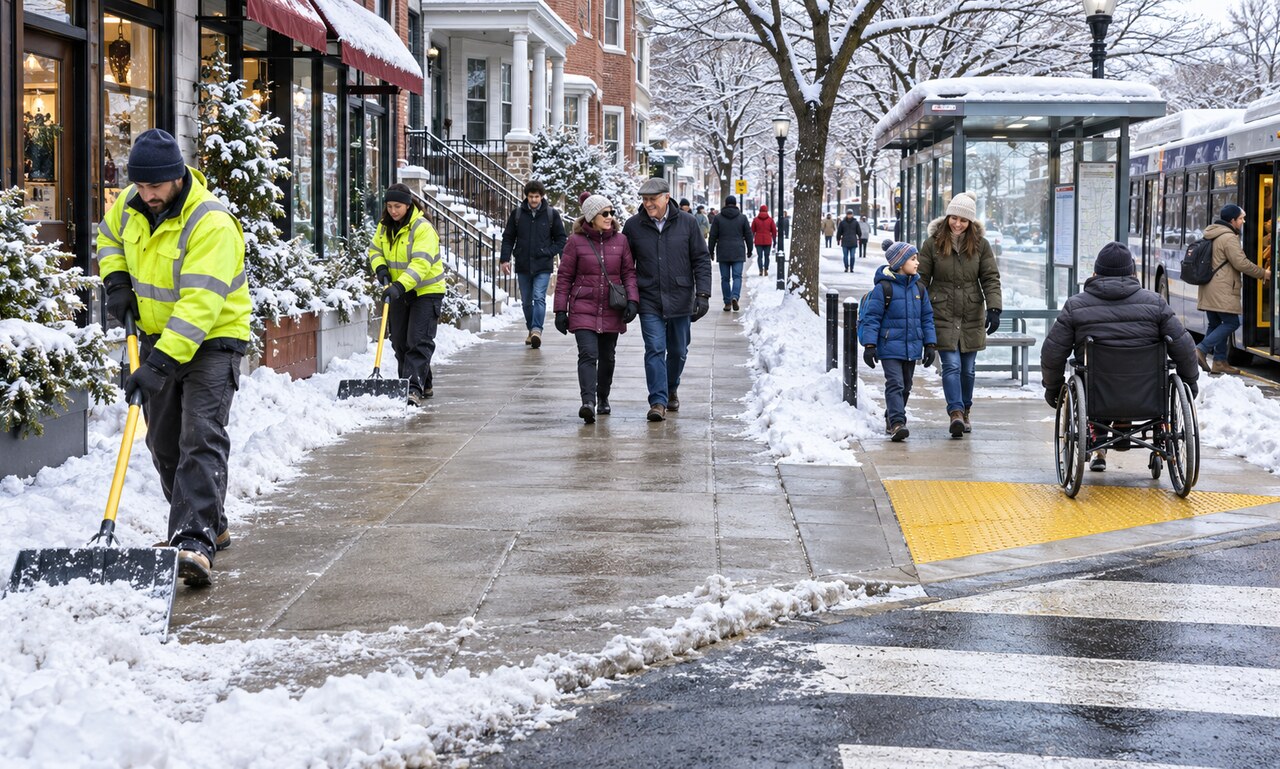
A well-cleared block has limited value if the next corner contains a snowbank. Winter accessibility depends on a connected path from entrance to sidewalk, across each intersection and onward to the destination. Bus stops, curb ramps and pedestrian islands are part of the same route.
Plowed road snow should not be stored where it blocks a crossing or narrows the walking space. Coordination between road and sidewalk crews prevents one operation from undoing the other.
Width supports different users
A narrow track may work for one person but not for a wheelchair, stroller or two people passing. Clearing the full practical width creates room for mobility devices and reduces the need to step into deep snow.
At curb ramps, the route needs a gentle, visible connection to the roadway. Ice ridges and slush collect where drainage is poor, turning an otherwise accessible corner into a barrier.
Timing changes the outcome
Snow is often easier to remove before foot traffic compresses it into a hard layer. Early clearing also ensures that morning trips are not treated as less important than later ones. Repeated snowfall may require several passes rather than a single daily visit.
Salt and grit can improve traction, but they work differently at different temperatures and can affect plants, animals, footwear and waterways. Mechanical clearing remains the foundation.
Responsibility should be easy to understand
Some cities clear sidewalks directly, while others require adjacent property owners to do it. Either model needs clear standards, realistic deadlines and a way to report gaps. Priority routes can protect access to transit and essential services, but residential connections still matter.
Winter maintenance reveals how a city values walking. When the route is continuous, wide and cleared promptly, snow becomes a condition to manage rather than a reason to exclude people from public life.
READ NEXT