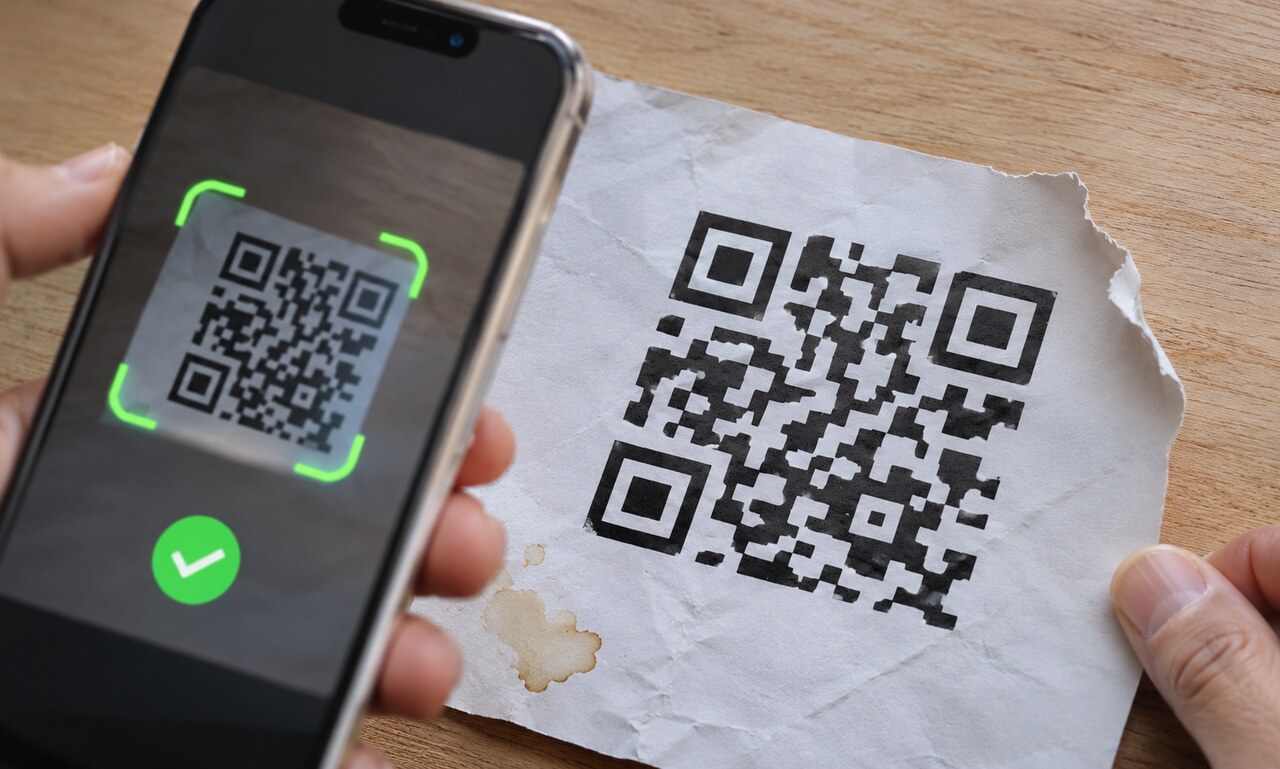
A QR code can remain readable after a corner is scratched, a label becomes stained or a small logo covers part of the pattern. This is not luck. The format is designed to tolerate a certain amount of missing or incorrect information.
The familiar square stores data across a grid of light and dark modules. It also includes structures that help a scanner find, orient and interpret that grid.
The large squares establish position
Three prominent markers near the corners allow a camera to recognize the code’s orientation. Because they are arranged asymmetrically, the scanner can determine which way the code is facing even when it is rotated.
Smaller timing and alignment patterns help the software map the rest of the grid. This matters when the code is viewed at an angle or printed on a slightly uneven surface.
Error correction rebuilds missing data
QR codes include additional information that can be used to recover damaged portions. The creator can choose among several error-correction levels. Higher correction improves resilience but leaves less room for the original message within a code of the same size.
The stored data is distributed across the symbol rather than placed as one fragile sequence. If some modules are unreadable, the scanner can use the surviving pattern and correction information to reconstruct what was lost.
Damage still has limits
A code is not indestructible. If too much of the grid is missing, if a position marker is obscured or if the print lacks sufficient contrast, scanning may fail. Glare, motion and poor focus can create temporary damage from the camera’s point of view even when the paper is intact.
The quiet border around the code is also important. Visual clutter placed too close to the grid can make it harder for software to identify the symbol’s boundaries.
Design for real conditions
A practical code should be large enough for the expected viewing distance, printed with strong contrast and tested on the material where it will appear. Dark modules on a light background remain the most reliable arrangement.
Decorative changes should be tested with multiple devices and camera angles. A design that scans perfectly on a bright monitor may perform poorly on curved packaging or under reflective light.
The apparent simplicity of a QR code hides a carefully structured system. Its ability to survive damage comes from planning for imperfection before the code is ever printed.
READ NEXT