A city can be physically connected and still feel difficult to navigate. A station entrance hides behind a building, two corridors look identical or a bus platform number appears only after the final turn. Wayfinding is the system that helps people build a usable mental map.
Signs are part of that system, but their value depends on where and how they appear.
Information belongs at decision points
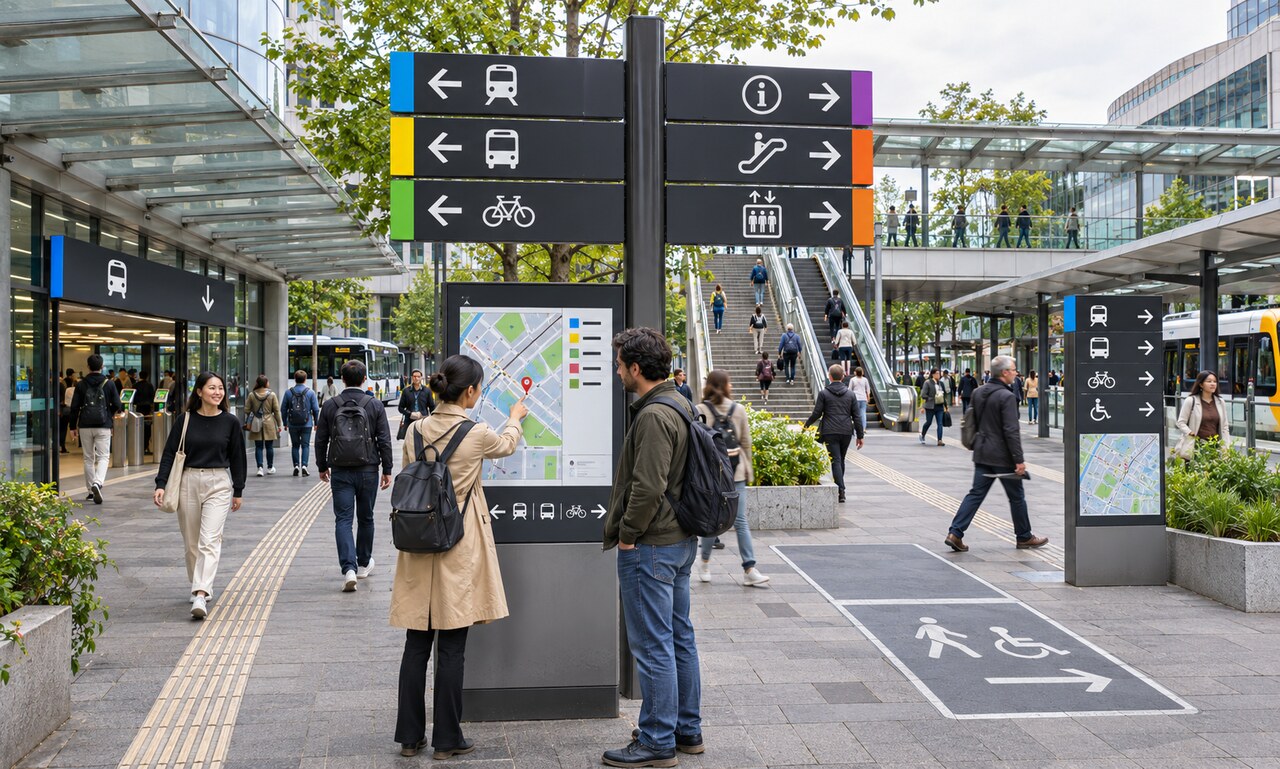
A direction is most useful before a person must choose a path. Signs should appear at entrances, intersections, level changes and transfers, then confirm the route after the choice. A single map at the beginning cannot answer every later question.
Repeated destination names and symbols create continuity. If the language changes from one sign to the next, users must stop and decide whether the destination has changed too.
Hierarchy prevents overload
People moving through a public place need the most important information first: the destination, direction and sometimes the distance or expected time. Secondary details can appear closer to the destination.
Strong contrast, readable type and adequate spacing allow a message to be understood quickly. Universal symbols can support recognition, but unfamiliar icons still need words or other context.
Accessibility changes the standard
Signs should be positioned and sized for people with different vision and mobility needs. Tactile lettering, braille, audible information and high-contrast maps can provide additional routes to the same message. Lighting must make the sign visible without glare.
Wayfinding should identify accessible entrances, elevators and step-free routes with the same prominence given to stairs and main doors. An accessible path is not useful if it is difficult to find.
The surroundings also give directions
Architecture, color, landmarks and sightlines can reinforce signs. A visible station entrance needs less explanation than one hidden behind an unmarked wall. Distinct materials or lighting can help people recognize different zones.
Maintenance matters because one missing sign can break a chain of instructions. Temporary construction routes need the same clarity as permanent ones, especially when familiar paths are closed.
Good wayfinding rarely draws attention to itself. It gives people confidence to keep moving, and it leaves enough clues that a wrong turn can be corrected without starting over.
READ NEXT