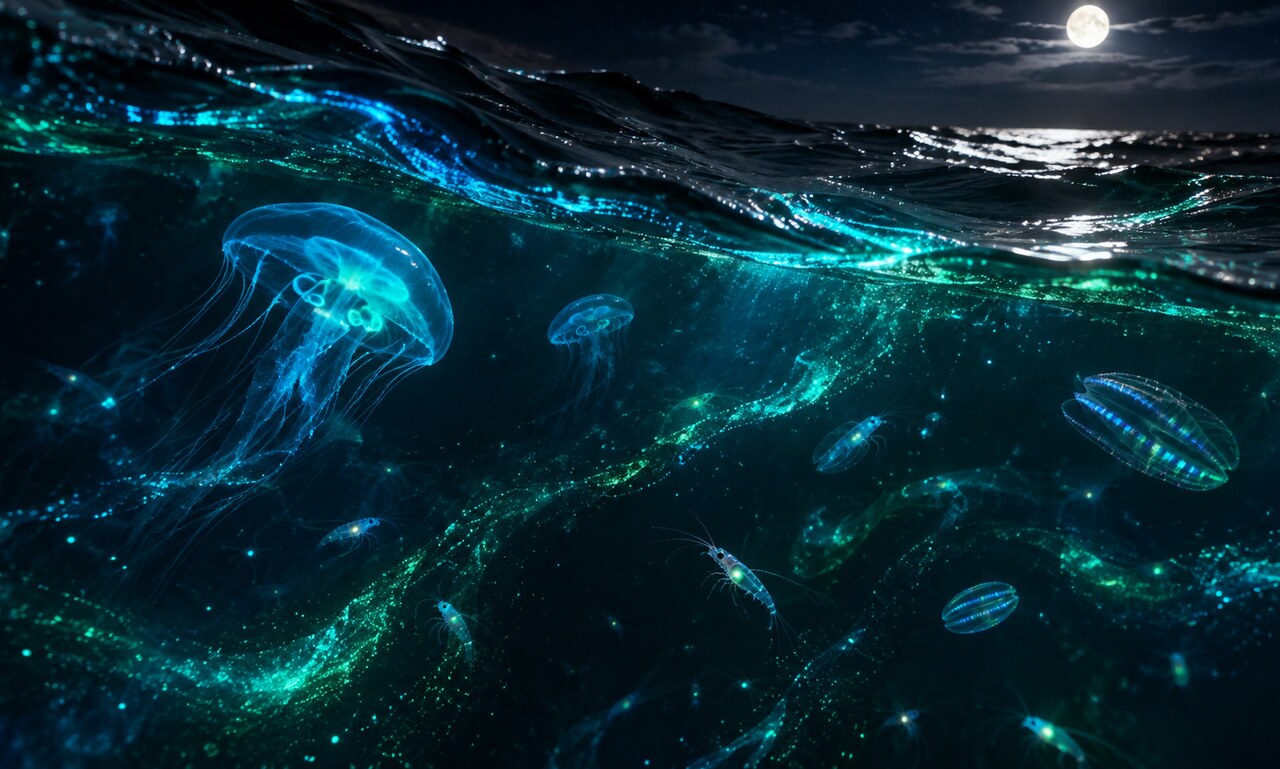
On certain nights, a breaking wave can appear to carry its own light. Footsteps at the water’s edge leave blue sparks, and the wake behind a boat briefly glows before darkness closes over it again.
The light is called bioluminescence. It is produced by living organisms through a chemical reaction, rather than reflected from the Moon or stored from the day. In coastal displays, microscopic plankton are often responsible for the visible glow.
Light made by chemistry
A bioluminescent reaction typically involves a light-producing molecule and an enzyme or related biological system that helps the reaction occur. The exact chemistry varies among organisms, but the result is similar: chemical energy becomes visible light.
Much marine bioluminescence appears blue or blue-green. Those wavelengths travel efficiently through seawater, making them especially useful in an environment where longer wavelengths are absorbed more quickly.
Why movement makes the water flash
Some plankton emit light when they are mechanically disturbed. A wave, a paddle or a moving hand can trigger a brief response. That is why a quiet patch of dark water may suddenly sparkle when something passes through it.
The flash may serve as defense. Light can startle a grazer or attract the attention of a larger predator that might eat the animal causing the disturbance. In the deep ocean, other organisms use light to lure prey, communicate or disguise their silhouette against faint light from above.
A visible bloom is a temporary event
Not every population of plankton glows, and not every glowing species creates a display bright enough to see from shore. Water temperature, nutrients, currents and local population density all influence when a bloom becomes noticeable.
The appearance can change from night to night. A beach that glowed yesterday may be dark today because the organisms moved, dispersed or encountered different conditions. Reports and photographs are therefore records of a particular place and moment, not a permanent feature.
Observe without assuming the water is safe
A beautiful glow does not by itself tell us whether a bloom is harmless. Some algal blooms can be associated with toxins or poor water quality, while many bioluminescent displays are not dangerous. Local advisories remain the appropriate guide for swimming, touching the water or collecting organisms.
The safest appreciation may be observational: watch the edge of a wave, look for sparks around moving water and let the light remain in its habitat.
Bioluminescence feels otherworldly because it makes a hidden process suddenly visible. Yet the glow is not an exception to nature. It is nature using chemistry with remarkable efficiency, turning a moment of disturbance into a signal bright enough for us to see.
READ NEXT