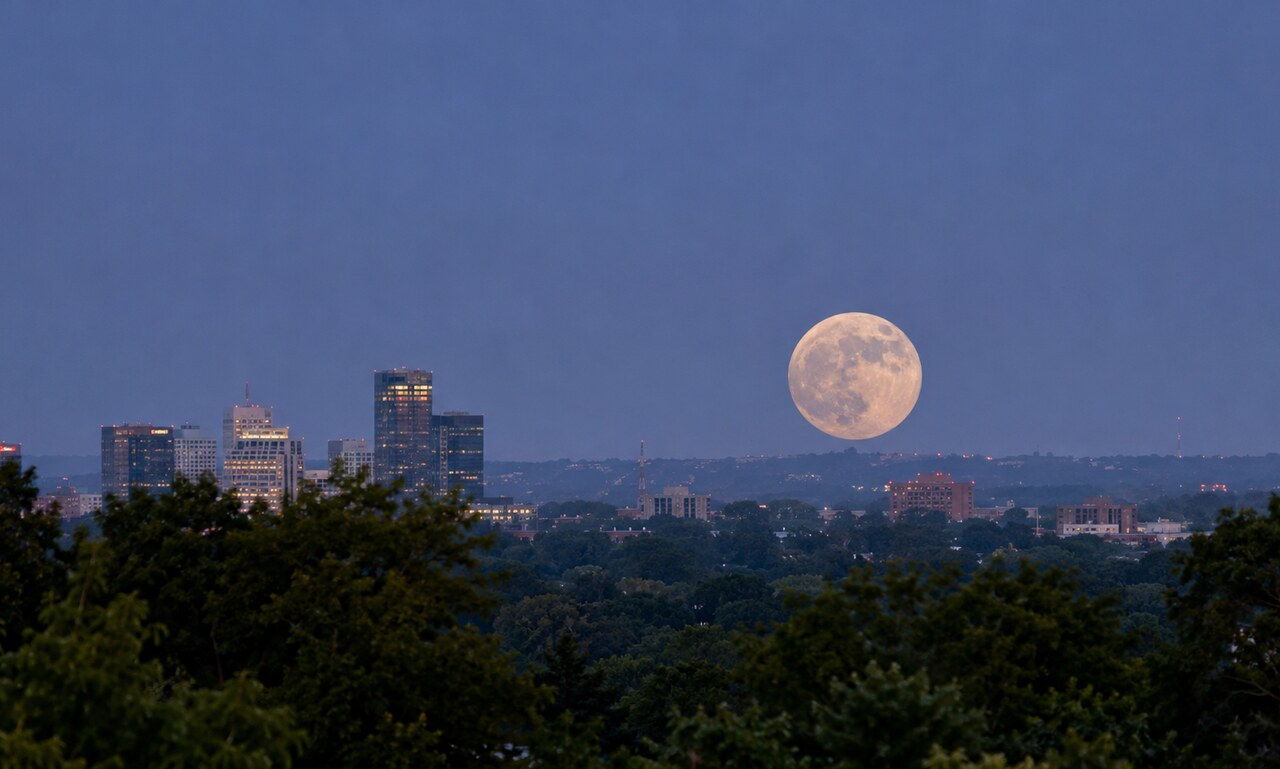
A full Moon rising behind rooftops can look enormous. Hours later, high in an open sky, the same Moon may seem smaller and more distant. The contrast is convincing enough to suggest that the Moon's image has physically changed size.
For most of the night, it has not changed by enough to explain the impression.
The Moon keeps nearly the same angle
Apparent size can be measured as an angle: how much of the viewer's field of vision an object occupies. The Moon's angular width varies somewhat because its orbit is not a perfect circle, but during a single rise its image remains close to the same size.
A camera makes the comparison simple. Photograph the Moon with the same lens settings near the horizon and later in the sky. When the images are measured, the lunar disk will be nearly equal in width.
The horizon supplies a scale
Near the ground, the Moon appears beside buildings, trees, hills and other familiar objects. Those references create a rich sense of distance and scale. High overhead, it sits in a largely featureless field with little to compare against.
This visual-context effect is commonly called the Moon illusion. Researchers continue to study the exact perceptual processes involved, but the surrounding scene clearly matters. The brain is not reading the lunar image like a ruler; it is interpreting the Moon as part of a three-dimensional landscape.
The atmosphere changes color, not the basic illusion
A low Moon often looks orange or red because its light travels through more of the atmosphere before reaching an observer. Airborne particles and molecules scatter shorter wavelengths more strongly, leaving warmer colors more prominent.
Turbulence and refraction can also make the disk shimmer or appear slightly flattened close to the horizon. These atmospheric effects are real, but they do not account for the dramatic sense that the Moon has grown.
A quick test reveals the constancy
Hold a small object at arm's length and use it to cover the Moon, or compare the Moon with a fingertip. Repeat the observation after it rises higher. The same object should cover approximately the same portion of the disk.
The Moon illusion is not a failure of vision. It is a reminder that seeing is an act of interpretation. The sky provides the light, while the brain uses context to decide what that light means.
READ NEXT