A worn cuff or loose seam can make a garment feel finished long before its fabric has reached the end of its useful life. Mending interrupts that conclusion. It treats damage as information about where an object has been used, not as an automatic instruction to replace it.
The first repair does not need to be elegant. It needs to be secure enough to return the garment to ordinary life.
Begin with the structure
Look closely at the damaged area before choosing a technique. A clean opening along a seam is different from a thin patch of fabric or a missing button. Repairing the wrong problem can pull the material out of shape or place new stress beside the original damage.
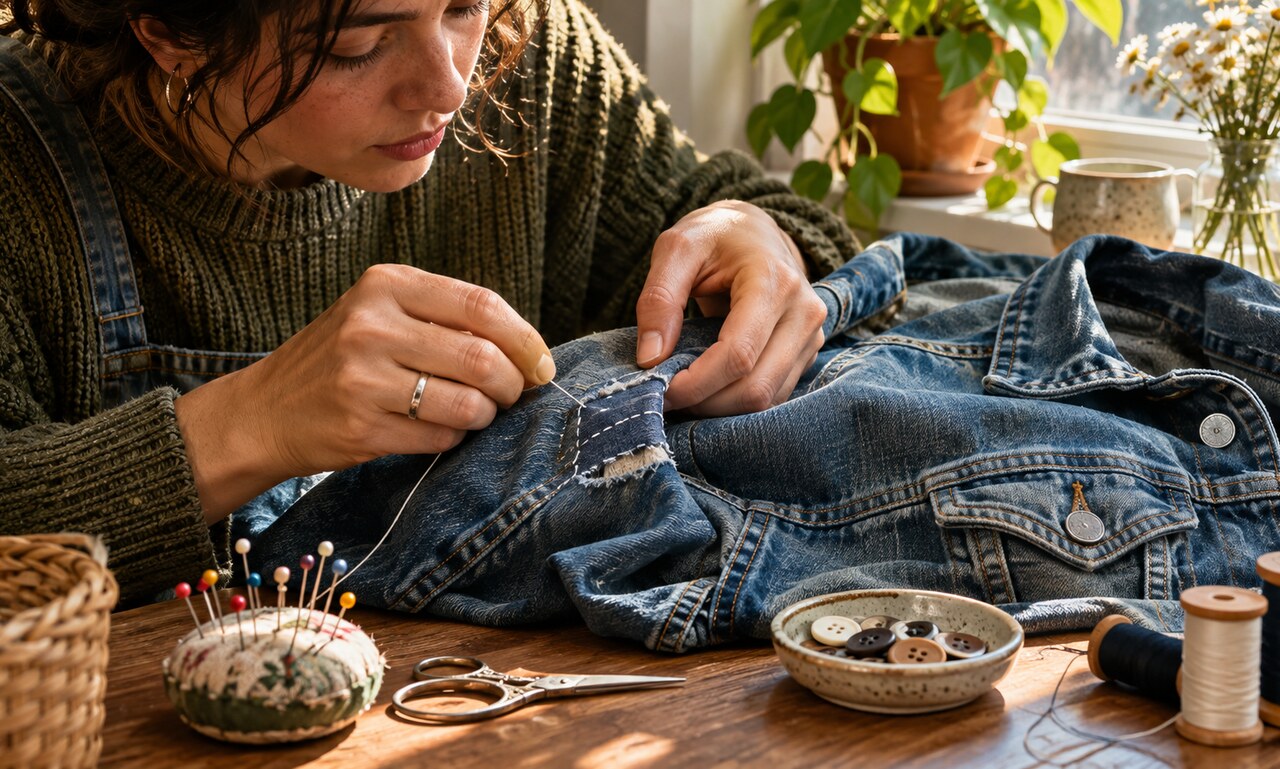
For a loose seam, match the original line and use small, consistent stitches. A worn area may need support from behind. A button should be attached with enough thread to hold, but enough space to move through the buttonhole without straining the fabric.
Choose visible or invisible repair
Some repairs try to disappear. Matching thread and careful placement can make a restored seam difficult to notice. Other repairs become part of the garment through contrasting stitches, a patch or decorative reinforcement.
Neither approach is more honest. The choice depends on the clothing, the damage and the person wearing it. A visible repair can celebrate continued use; a subtle repair can preserve the original appearance.
Work slowly around weak fabric
Old fabric may be fragile beyond the obvious hole. Pulling thread too tightly can create puckering or cause the next tear. Support a wider area than the visible damage and test the tension as you go.
Good light matters. So does a comfortable needle and thread suited to the material. Heavy denim can accept a stronger repair than a fine knit, which may require a flexible technique that moves with the fabric.
The repair records a relationship
A favorite garment has value that is difficult to express through price alone. It fits in a familiar way. It may be connected to a person, a trip or a period of life. Mending recognizes that history without pretending the object can remain unchanged.
The repaired place may never look new. That is not necessarily failure. It shows that usefulness can include evidence of care.
A needle, thread and a few patient minutes will not solve every problem in clothing production or consumption. But they can change one decision. Instead of asking what should replace a damaged garment, we begin by asking whether it can continue.
READ NEXT