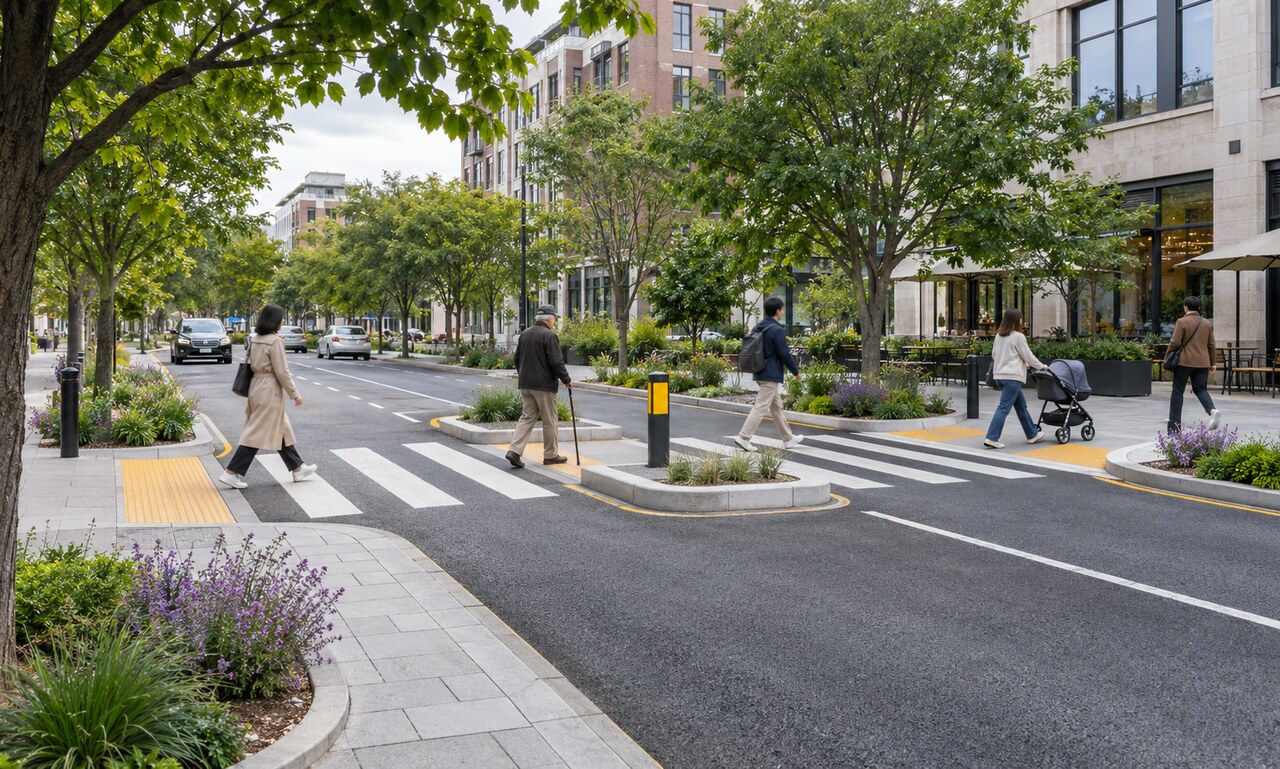
A painted crossing can mark where people should walk without making the journey comfortable. The real experience depends on how far someone must travel, whether drivers can see them and how clearly the street communicates who moves next.
Shorter distance reduces exposure
Curb extensions bring the sidewalk closer to the travel lane, shortening the distance between safe edges. A refuge island can divide a wide road into two smaller decisions, allowing someone to pause between directions of traffic.
These features are especially useful for children, older adults and anyone who moves at a slower pace.
Visibility must work both ways
Drivers need a clear view of people waiting to cross, and pedestrians need to see approaching vehicles. Parked cars, landscaping and street furniture should not block that relationship near the corner.
Lighting matters after dark. It should illuminate the person and the crossing area without creating glare that hides the space beyond it.
Speed shapes every detail
A driver traveling more slowly has more time to notice and respond. Narrower lanes, raised crossings and tighter turning geometry can reinforce an appropriate speed through the design of the street itself.
Signs and markings help, but they are strongest when the physical layout supports the same message.
Timing should reflect real walkers
Signal phases must give people enough time to begin and complete the crossing. Countdown displays make the remaining time easier to understand, while an accessible signal can communicate the phase through sound and touch.
Predictability creates confidence
A good crossing makes movements legible. The path is obvious, turning vehicles approach carefully and the next safe place is visible from the starting curb.
Safety is not only the absence of a collision. It is the ability to make an ordinary trip without feeling that the street has asked for courage.
READ NEXT