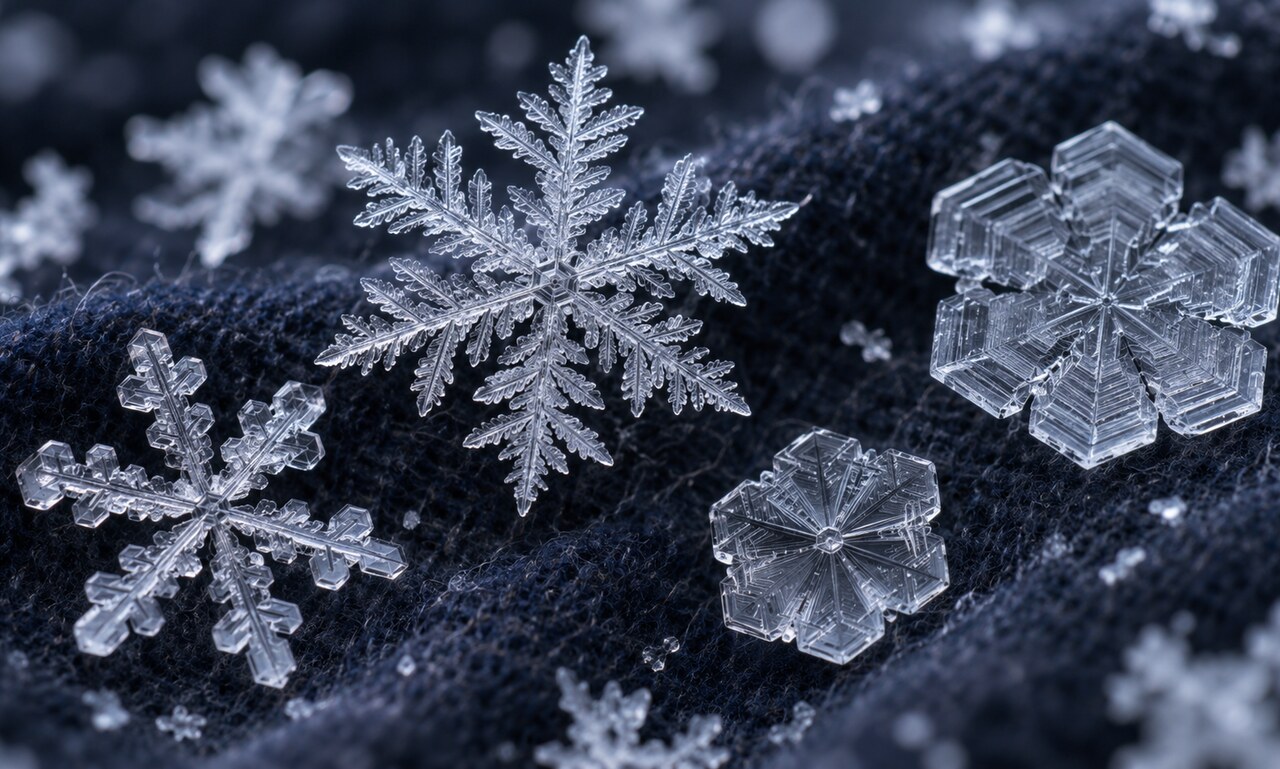
A snowflake begins around a tiny particle suspended in a cloud. Water vapor freezes onto that nucleus and builds a crystal directly from the air.
The familiar six-sided symmetry comes from the way water molecules arrange themselves when they form ice.
Ice establishes the basic geometry
In solid ice, water molecules connect in a hexagonal structure. As vapor joins the growing crystal, that molecular arrangement produces six primary directions of growth.
This is why natural snow crystals commonly show six arms or six sides rather than five or seven. The precise shape varies, but the underlying symmetry remains.
Conditions change during the fall
A crystal moves through layers of cloud with different temperatures and amounts of water vapor. Some conditions favor flat plates. Others encourage columns, needles or branching arms.
When growth is rapid at the corners, branches extend outward. Small changes in humidity and temperature can add side branches, plates or ridges as the crystal travels.
The arms share one journey
The six arms of a snow crystal grow close together, so they experience nearly the same changing conditions. This helps them develop similar patterns. They are not perfectly identical, however. Tiny differences in collisions and airflow alter the details.
Why no two look exactly alike
Each crystal follows a complex path through the cloud. The number of possible changes is enormous, making exact duplicates extraordinarily unlikely. Simpler crystals can look alike, but detailed branching preserves the history of an individual fall.
Once on the ground, crystals can melt, break or join together. The delicate form visible on a dark sleeve is a temporary record of water vapor becoming ice, one molecule at a time.
READ NEXT