A modern roundabout asks drivers to slow, look and yield before entering a one-way circular roadway. Unlike an all-way stop, it does not require every vehicle to halt. If the entry is clear, traffic can continue at a controlled speed.
The geometry does much of the work before a sign has to.
Curves replace the straight path
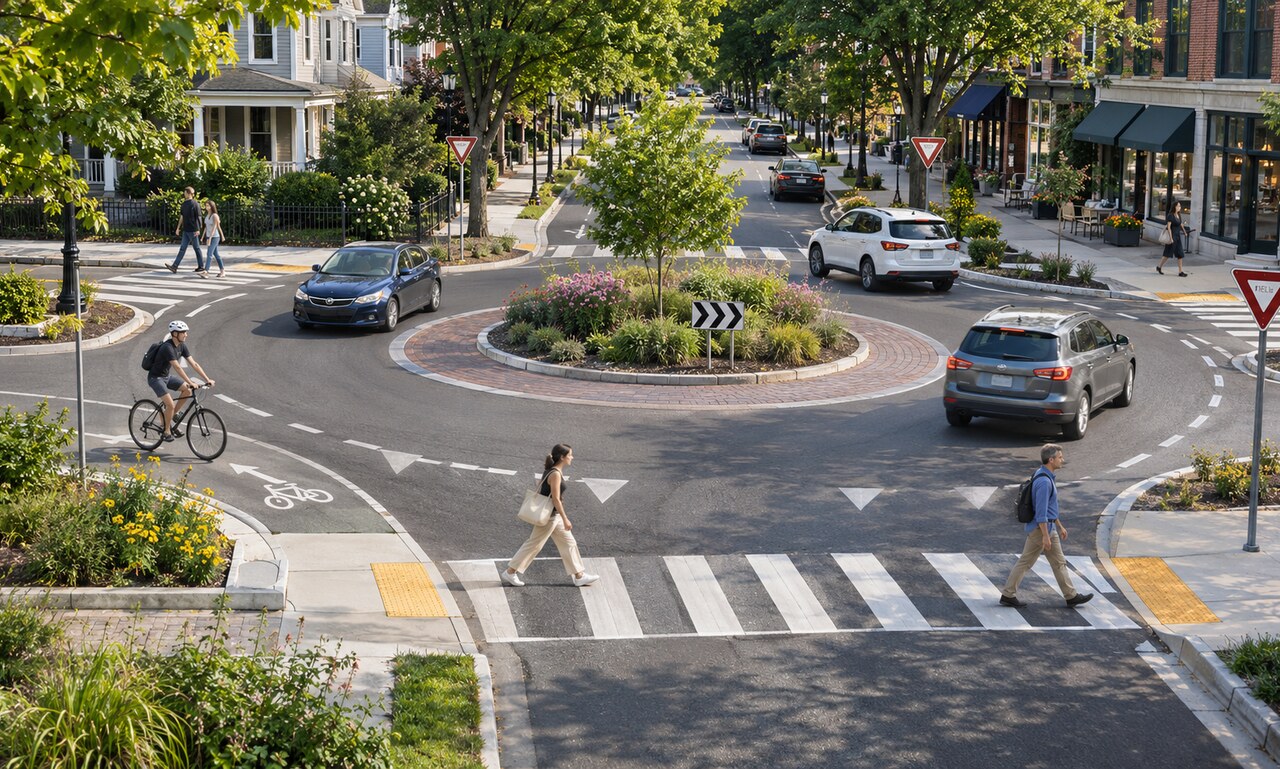
Approach lanes aim vehicles toward the central island rather than directly across the intersection. This deflection makes high-speed entry uncomfortable and gives drivers time to see circulating traffic. Raised islands and narrowed entries reinforce the path.
A well-designed roundabout should make the intended movement obvious. An intersection that can be driven straight through at speed has missed one of the design's main safety benefits.
Yielding keeps the circle moving
Drivers entering yield to vehicles already circulating. Because traffic inside the roundabout has priority, it can leave without stopping for a new arrival. The system works through gaps: each approach uses available space in the circulating stream.
At moderate traffic levels, this can reduce delay and idling compared with signals or stop signs. At very high volumes or poorly balanced approaches, queues can still form.
Conflict angles become less severe
A conventional intersection includes right-angle crossings and head-on turning paths. A roundabout converts most of those movements into merging and diverging conflicts at lower speeds. Crashes can still occur, but the geometry reduces the likelihood of the most severe types.
Single-lane roundabouts are generally easier to read. Multilane versions require clear advance signs and lane markings so drivers choose the correct path before entering.
People outside cars need direct routes
Pedestrian crossings are usually set back from the circle, where people cross one direction of traffic at a time with a refuge island between. Drivers have more space to yield without blocking the circulating lane. Cyclists may merge with slow traffic or use a separate path, depending on speed and design.
Accessibility requires detectable edges, clear crossings and predictable alignment, since some pedestrians cannot rely on visual gaps alone.
A roundabout does not eliminate the need for judgment. It creates an intersection where slowing and yielding are built into the shape, allowing movement to continue without making speed the organizing principle.
READ NEXT