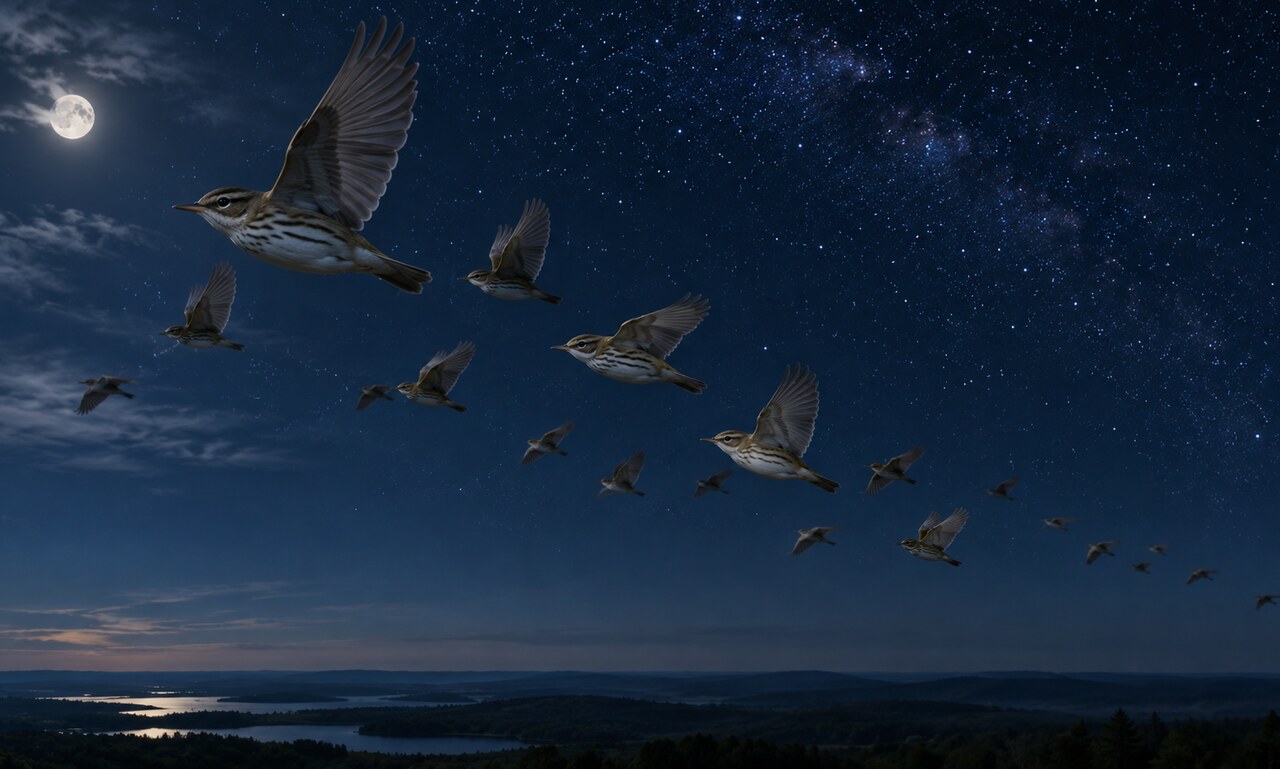
On many spring and autumn nights, birds move overhead while the streets below are quiet. Some travel alone, others in loose groups, crossing hundreds or thousands of kilometers between breeding and wintering grounds.
Their navigation does not depend on one perfect compass. Birds combine several kinds of information, and the importance of each cue changes with weather, location and experience.
The night sky provides direction
Some nocturnal migrants can use patterns of stars to maintain a course. They are not following one bright star as a fixed destination. Instead, the rotation of the night sky helps them identify the general center around which the stars appear to move.
Young birds can develop this ability before making a full migration. The sky provides a broad directional reference, while inherited tendencies help establish when and where to travel.
A magnetic sense works through cloud
Birds can also detect information from Earth’s magnetic field. This sense offers a compass when stars are hidden and may help birds understand their position along a route.
The biological mechanisms are still an active area of study. Evidence suggests that more than one process may be involved, including light-sensitive reactions in the eye and magnetic particles associated with sensory systems.
Landscapes become familiar
Experience adds detail. Coastlines, rivers, mountain ranges and even patterns of human settlement can guide birds along known routes. Smell and sound may also contribute for some species.
An older bird returning to a familiar region has information that a first-time migrant does not. Navigation becomes a combination of inherited direction and learned geography.
Weather can reshape the journey
Wind affects both speed and effort. A favorable tailwind can carry birds far in one night, while strong crosswinds push them away from the intended route. Migrants may wait for suitable conditions or adjust after being displaced.
Artificial light adds another challenge. Bright buildings can attract and disorient birds, especially in low cloud or fog. Reducing unnecessary lighting during peak migration periods can make urban airspace safer.
A journey made from many cues
No single signal explains every species or every flight. The remarkable part is the integration: stars above, a magnetic field around the planet, weather in the present and landscapes remembered from earlier journeys.
Night migration is largely invisible from the ground, but it is not uncertain movement. It is navigation carried out through a world of cues most people rarely notice.
READ NEXT