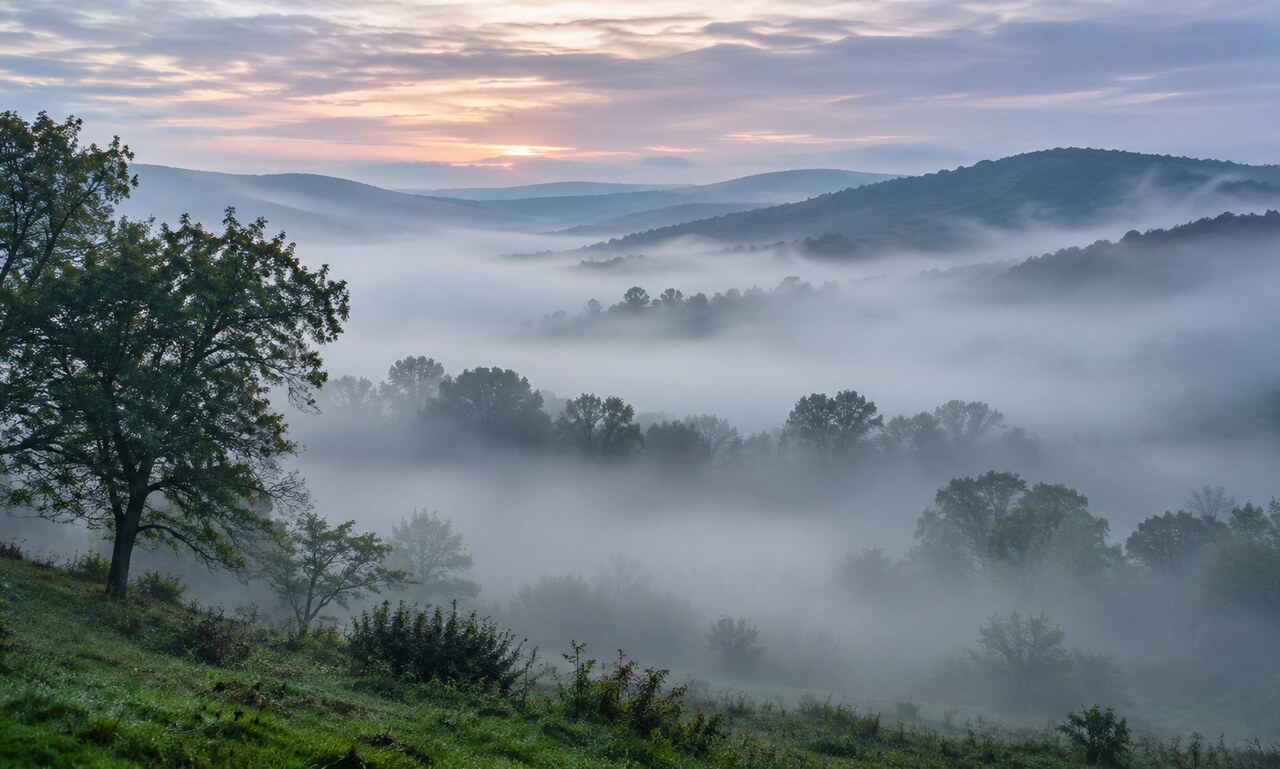
Fog can erase a distant building while leaving the nearest tree sharply visible. A familiar road becomes a sequence of short views, and the air seems to acquire texture. What we are seeing is a cloud at ground level.
Fog forms when moist air cools enough for water vapor to condense onto tiny particles. The resulting droplets are small enough to remain suspended, but numerous enough to scatter light and reduce visibility.
Cooling brings the air to saturation
Air can contain water vapor without appearing cloudy. As that air cools, it reaches a point at which it can no longer keep the same amount of water in vapor form. Condensation begins, creating microscopic liquid droplets.
The temperature at which this happens is called the dew point. If cooling occurs near the ground and the air is relatively still, fog may develop rather than a higher cloud.
Different conditions create different fog
On clear, calm nights, the ground can lose heat and cool the air directly above it. This may produce radiation fog, especially in low areas where cooler air collects.
Advection fog forms when moist air moves across a colder surface, such as cool land or water. In valleys, fog can gather when cold, dense air settles beneath warmer air. Along coasts, temperature differences between air and water can create broad banks that move with the wind.
Why fog disappears
Morning sunlight can warm the ground and the air above it. As the temperature rises, the relative humidity falls and suspended droplets evaporate back into invisible water vapor. Stronger wind can also mix the fog with drier air.
A fog layer may appear to lift before it vanishes. The lowest air warms first, raising the base of the cloud and revealing the ground while a gray layer remains overhead.
Visibility changes faster than the scene
Fog does not need to be uniform. One part of a route may be clear while another suddenly becomes difficult to read. This makes driving hazardous: distance and speed are harder to judge, and objects emerge with less warning.
The safest response is to slow down, use appropriate low-beam lighting and leave more space. Bright high beams can reflect from droplets and make visibility worse.
Fog feels mysterious because it hides solid objects, but its own presence is physical and ordinary. Water, temperature and tiny airborne particles briefly combine to make the atmosphere visible from the inside.
READ NEXT