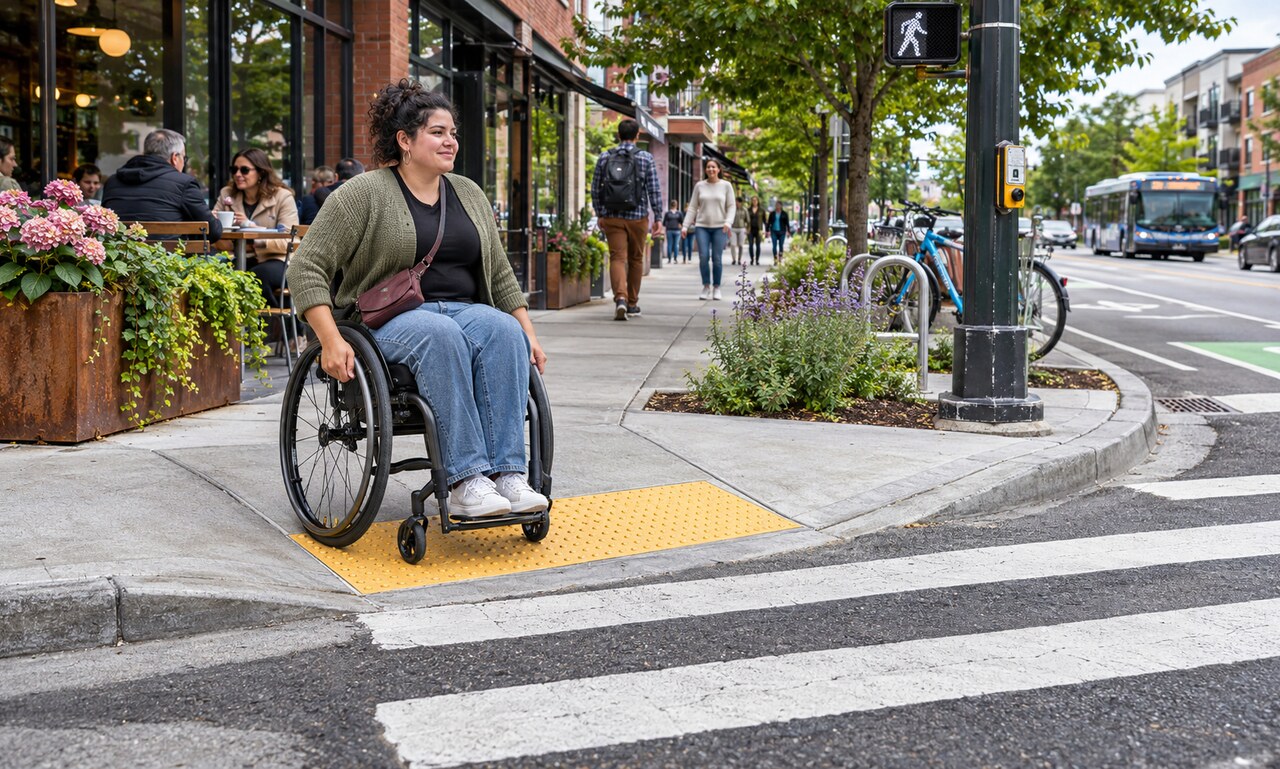
A curb cut is a simple transition: the sidewalk slopes down to meet the street rather than ending at a vertical edge. Its physical form is modest, yet it changes who can move through a neighborhood without assistance.
The feature also demonstrates a larger principle. When a city removes a barrier for disabled people, many other residents often benefit.
The ordinary curb can be an obstacle
A raised curb separates pedestrians from vehicles and helps manage drainage, but it can block a wheelchair user from entering or leaving a crossing. Without a ramp, the person may need to find a driveway, travel in the street or rely on help.
Disability advocates pushed cities and institutions to recognize that public space was not truly public when basic routes excluded them. Curb cuts became an important part of wider demands for access and civil rights.
Good design is more than a slope
The ramp needs a manageable grade, enough width and a level landing. It should align with the intended crossing rather than direct someone toward moving traffic. Drainage must prevent water from collecting at the bottom.
Tactile warning surfaces provide information to people who are blind or have low vision by marking the boundary between sidewalk and street. Color contrast, clear crosswalks and usable signal timing strengthen the route.
Benefits extend across daily life
Parents pushing strollers, travelers pulling luggage, workers moving carts and cyclists walking a bicycle all use curb cuts. The smoother connection reduces effort and makes a continuous pedestrian route possible.
These additional benefits do not erase the feature's accessibility purpose. They show that people move through cities in many ways and that rigid assumptions about a standard pedestrian leave almost everyone out at some point.
Maintenance decides whether access lasts
A curb cut blocked by snow, standing water, construction or a parked vehicle is not accessible. Surface damage can create a serious hazard. Cities need inspection, rapid repair and enforcement as much as they need correct plans.
Placement also matters across an entire journey. One excellent corner cannot compensate for a missing ramp at the next intersection or an inaccessible destination.
Curb cuts are now familiar enough to disappear into the streetscape. That familiarity is an achievement, but it should not make their history invisible. The small slope carries a durable lesson: design improves when the people facing a barrier help define how it is removed.
READ NEXT