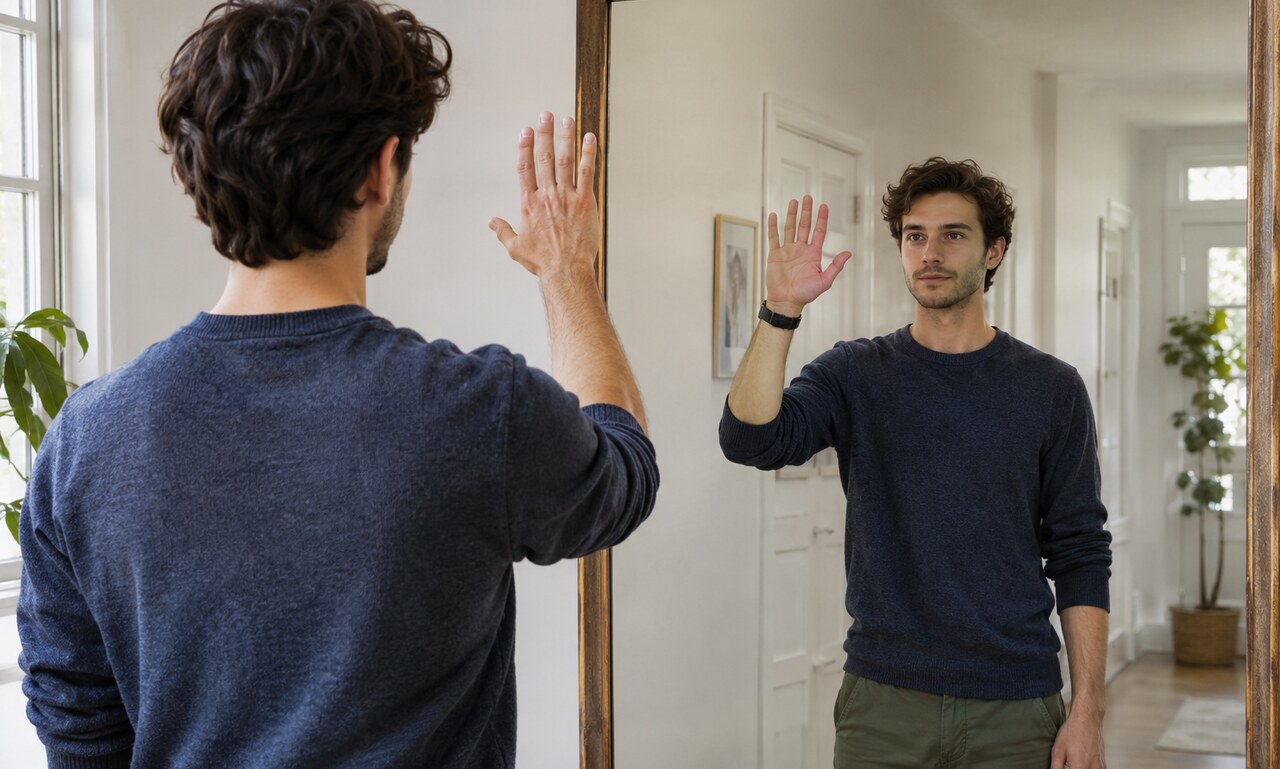
Raise your right hand in front of a mirror and the reflection appears to raise its left. Printed words look backward, yet the top of your head remains at the top. This makes it seem as though the mirror reverses left and right but leaves up and down untouched.
The mirror is doing something simpler: it reverses the direction perpendicular to its surface.
Front and back exchange places
Light travels from each point on the body to the mirror and reflects toward the eyes. The image appears the same distance behind the glass as the object stands in front of it. A nose that points toward the mirror appears to point out from the reflected world.
The image's vertical and horizontal positions are not swapped. A mark on the physical right side of the mirror remains on the right side of the image. What changes is the depth axis: front becomes back.
Comparison creates the left-right effect
When we imagine standing where the reflection stands, we usually picture turning around to face ourselves. That mental rotation exchanges left and right. We then compare the reflection with the rotated person and attribute the difference to the mirror.
If instead we imagined flipping forward over a horizontal bar, top and bottom would exchange. The mirror has not selected either rotation; our chosen way of matching the two figures creates the apparent reversal.
Writing exposes direction
Letters are asymmetric shapes with an intended reading direction. A mirror preserves their position on the glass but reverses their depth, producing a pattern that no longer matches the version we expect to see when facing the same way as the page.
Writing can be designed backward so that its reflection reads normally. The familiar use of mirrored lettering on emergency vehicles relies on the same geometry when a driver sees the text in a rear-view mirror.
The reflection follows the light
A flat mirror forms a virtual image rather than a physical object behind the glass. The brain traces reflected rays backward in straight lines and locates the image where those lines appear to meet.
The puzzle becomes clearer once the comparison is separated from the optics. The mirror changes front and back. We supply the imagined turn—and with it, the impression that left and right have traded places.
READ NEXT